

We live in an era where doing more with less is no longer a competitive advantage — it’s a survival requirement. In 2026, organizations face a relentless convergence of rising operational costs, accelerating technological change, and increasingly sophisticated customer expectations. The margin for inefficiency has never been thinner.
Against this backdrop, a new conceptual framework has emerged to help businesses, technologists, and leaders think more systematically about how efficiency is achieved, sustained, and scaled. That framework is RKBVJRC — a modern, multi-dimensional approach to smarter efficiency that goes beyond simple cost-cutting or process streamlining.
RKBVJRC is not a product you buy or a software you install. It is a strategic lens through which organizations can evaluate how intelligently they are operating across seven critical dimensions: Real-time data integration, Knowledge-centric operations, Business process automation, Value-driven decision frameworks, Just-in-time optimization, Resource-efficient technologies, and Continuous improvement culture. Together, these seven pillars form a coherent and actionable map for achieving what efficiency actually means in 2026 — not just speed, but intelligence; not just savings, but sustainability.
This article unpacks each component of RKBVJRC, examines the technological and operational forces that make this framework timely, explores its practical applications across industries, and looks at the challenges organizations must navigate to implement it effectively.
What is RKBVJRC?
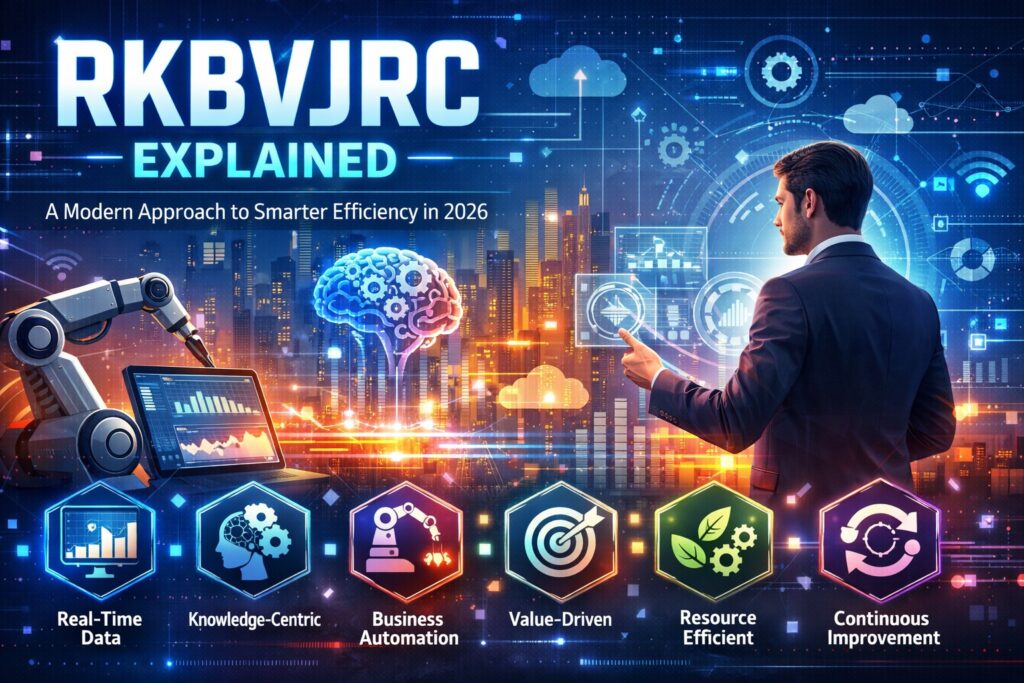
At its core, RKBVJRC is a conceptual efficiency framework designed for the complexity of the modern operating environment. The acronym encapsulates seven interdependent principles that, when applied in combination, enable organizations to make smarter decisions faster, reduce waste across operations, and build the adaptive capacity needed to compete in an increasingly volatile world.
The framework emerged from a growing recognition in both business and technology circles that traditional efficiency models — built around linear processes, siloed data, and periodic reviews — are fundamentally misaligned with how organizations actually operate today. Businesses now run on continuous data streams, cross-functional workflows, distributed workforces, and customer journeys that span dozens of digital and physical touchpoints. Managing this complexity with legacy thinking creates friction, waste, and strategic blind spots.
RKBVJRC was conceptualized as a response to this misalignment. It draws from disciplines including operations management, data science, systems thinking, behavioral economics, and organizational psychology to create a framework that is both practically grounded and intellectually robust.
For 2026 specifically, RKBVJRC is particularly relevant because organizations are at an inflection point. Many have made significant investments in AI, cloud infrastructure, and automation over the past several years, but have yet to realize the full return on those investments. The framework provides the connective tissue between technology investment and operational outcome — helping organizations understand not just what tools to use, but how to use them in service of genuine, measurable efficiency gains.
About Filkizmiz253 – From Random Username to Global Digital Phenomenon
Core Components of RKBVJRC
R — Real-Time Data Integration
The first pillar of RKBVJRC is perhaps its most foundational. Real-time data integration refers to the seamless, continuous flow of accurate data across an organization’s systems, teams, and decision points. In practice, this means breaking down the data silos that have historically separated sales from operations, marketing from product, and finance from strategy.
Organizations that operate on stale or fragmented data are essentially navigating with an outdated map. Real-time integration ensures that every decision — from a frontline customer interaction to a boardroom strategy session — is informed by the most current available intelligence. This is not simply about having dashboards; it is about creating an organizational nervous system that responds in real time to signals from the market, the supply chain, the customer base, and the internal operation itself.
K — Knowledge-Centric Operations
Knowledge-centric operations place the organization’s accumulated intellectual capital — its institutional knowledge, expertise, processes, and lessons learned — at the center of how work gets done. Rather than treating knowledge as a byproduct of work, this pillar treats it as a primary input.
In practical terms, this means investing in knowledge management systems, fostering cultures of documentation and learning, and ensuring that expertise is captured and distributed rather than siloed in individual minds. In 2026, where employee turnover remains elevated and remote work has made informal knowledge transfer harder, this pillar has taken on new urgency. Organizations that lose critical knowledge when employees leave, or that repeatedly solve the same problems because lessons are never codified, are operating at a significant efficiency deficit.
B — Business Process Automation
Automation is not new, but the scope and sophistication of what can be automated has expanded dramatically in recent years. Business process automation, as a pillar of RKBVJRC, is about intelligently identifying and automating the repetitive, rules-based, and high-volume tasks that consume human time without requiring genuine human judgment.
The key word here is “intelligently.” Poorly implemented automation can create new inefficiencies, introduce errors at scale, and erode customer experience. The RKBVJRC approach to automation is deliberately scoped — it begins with a rigorous process audit to identify where automation adds genuine value, and it preserves human involvement where judgment, creativity, and empathy are required. When done well, automation frees people to focus on the work that actually requires them.
V — Value-Driven Decision Frameworks
Efficiency without direction is just speed. The value-driven decision component of RKBVJRC ensures that the efficiency gains achieved across the other pillars are being directed toward outcomes that actually matter — to customers, to stakeholders, and to the organization’s long-term mission.
This pillar introduces structured decision-making frameworks that force organizations to ask, at every juncture, whether a given action, investment, or process is creating genuine value or simply perpetuating activity. It draws on concepts from lean methodology, outcome-based management, and modern strategy theory to create decision filters that keep organizations aligned with their highest-priority goals even as the pace of operations accelerates.
J — Just-in-Time Optimization
Borrowed and expanded from manufacturing’s just-in-time production philosophy, this pillar applies the principle of temporal precision to virtually every operational domain. Just-in-time optimization is about ensuring that resources — whether they are physical inventory, digital infrastructure, human capacity, or financial capital — are deployed at the precise moment they are needed, in precisely the quantity required.
The waste that accumulates when organizations over-provision, over-staff, or over-invest is enormous. Just-in-time optimization, enabled by modern forecasting tools, predictive analytics, and flexible sourcing arrangements, allows organizations to dramatically reduce this waste without introducing fragility. The goal is to be lean without being brittle — to run efficiently without running out.
R — Resource-Efficient Technologies
The second R in RKBVJRC refers to the deliberate selection and use of technologies that maximize output relative to the resources they consume — whether those resources are energy, computing power, human attention, or financial investment. Resource-efficient technology selection is both an economic and an environmental imperative in 2026.
This pillar encourages organizations to audit their technology stacks through an efficiency lens, asking not just whether a given tool is capable, but whether it is the most resource-effective solution for the job. It also encompasses the design of software and systems themselves — advocating for architectures that scale efficiently, consume energy responsibly, and avoid the technical debt that ultimately makes future operations more expensive and complex.
C — Continuous Improvement Culture
The final pillar is arguably the most important, because it is the one that gives the others durability. A continuous improvement culture is an organizational environment in which the identification, testing, and implementation of improvements is not a periodic event but a constant, embedded practice.
Drawing from methodologies like Kaizen, Agile, and DevOps, this pillar recognizes that no efficiency framework — including RKBVJRC itself — is a destination. The organizations that will sustain efficiency advantages in the late 2020s will be those that have built the reflexes, habits, and incentive structures to keep improving relentlessly. This requires psychological safety, leadership modeling, measurement systems, and a genuine cultural commitment to learning from failure.
8tshare6a Software Download: A Comprehensive Guide
Why Modern Approaches to Efficiency Matter in 2026
Three converging forces have made 2026 a critical year for rethinking efficiency.
The first is technological acceleration. Artificial intelligence, the Internet of Things, and advanced analytics have matured from experimental technologies to operational realities for a growing number of organizations. These tools offer unprecedented efficiency potential — but only for organizations that know how to absorb and apply them. For the rest, they represent costly distractions or half-implemented initiatives that consume resources without delivering returns.
The second force is the enduring complexity of the post-pandemic operating environment. The disruptions of the early 2020s reshaped supply chains, workforce structures, customer behaviors, and competitive landscapes in ways that are still playing out. Organizations are managing more variables, more uncertainty, and more stakeholder demands than ever before. Traditional efficiency approaches, built for more predictable environments, are simply not adequate to this complexity.
The third force is competitive pressure. In a global economy where margins are thin and switching costs for customers are low, efficiency is increasingly a direct driver of competitive advantage. Organizations that can deliver more value at lower cost — not by cutting corners, but by operating genuinely smarter — have a structural advantage that compounds over time. Those that cannot are perpetually on the back foot.
Key Technologies Underpinning Smarter Efficiency
No discussion of modern efficiency is complete without examining the technological infrastructure that makes it possible.
Artificial Intelligence and Machine Learning sit at the heart of the 2026 efficiency revolution. AI enables organizations to automate not just rote tasks but judgment-intensive processes — underwriting decisions, customer service triage, demand forecasting, quality control, and much more. Predictive analytics, powered by ML models trained on organizational and market data, allow businesses to anticipate problems and opportunities rather than simply reacting to them. The efficiency gain from moving from reactive to predictive operations is often transformational.
Data Platforms and Real-Time Insights are the infrastructure layer that makes intelligent operations possible. Modern cloud-based data platforms can ingest, process, and surface insights from enormous data volumes with latency measured in seconds rather than days. For organizations that previously ran on weekly or monthly reporting cycles, this shift fundamentally changes the speed and quality of decision-making across every function.
Automation and Intelligent Systems have expanded well beyond robotic process automation of back-office tasks. In 2026, intelligent automation encompasses customer-facing chatbots and virtual agents, autonomous logistics and fulfillment systems, AI-assisted software development, and smart building management systems that optimize energy consumption in real time. The breadth of what can now be automated — intelligently and reliably — is vast.
Integration and Interoperability deserve special mention because they are often the unglamorous bottleneck between technology investment and efficiency realization. Organizations that have invested heavily in AI and automation but have not solved their integration challenges find that their tools cannot communicate, their data cannot flow freely, and their systems create friction rather than removing it. Modern integration platforms and API-first architectures are essential to making the rest of the technology stack function as a coherent whole.
Practical Applications of RKBVJRC
The framework’s value is most clearly demonstrated in its practical applications across different organizational domains.
In business operations, RKBVJRC manifests as streamlined procurement processes driven by real-time supplier data, automated financial close processes that reduce cycle times from weeks to days, and predictive maintenance programs that eliminate unplanned equipment downtime. Each of these represents a direct application of the framework’s principles: real-time data informing just-in-time resource deployment, automated by intelligent systems, guided by value-driven priorities.
In customer experience, organizations applying RKBVJRC principles are using AI-powered personalization engines to deliver relevant, timely interactions at scale, automating routine customer service inquiries while routing complex issues to the right human agents, and using real-time behavioral data to anticipate customer needs before they are explicitly expressed. The result is customer experiences that feel more attentive and responsive without requiring proportionally more human effort to deliver.
In product development, the framework supports faster, leaner innovation cycles. Knowledge-centric operations ensure that lessons from previous development cycles inform the next. Real-time customer feedback integration shortens the loop between market signal and product response. Just-in-time resource allocation means development teams are neither starved of what they need nor burdened with unnecessary overhead.
In smart systems — including smart buildings, smart factories, and intelligent infrastructure — RKBVJRC finds perhaps its most literal expression. IoT sensors provide real-time operational data, AI systems optimize energy and resource consumption dynamically, and continuous improvement loops use operational data to progressively refine system performance. A smart factory operating on these principles can reduce energy consumption, minimize waste, and maximize throughput in ways that would have been impossible to manage manually.
Benefits of Adopting a Smarter Efficiency Framework
Organizations that successfully implement RKBVJRC-aligned strategies can expect benefits that extend well beyond simple cost reduction.
Faster decision-making is perhaps the most immediately felt benefit. When real-time data flows freely, decision frameworks are clear, and knowledge is readily accessible, the time from question to answer compresses dramatically. This speed advantage compounds across thousands of decisions made at every level of the organization.
Operational cost savings accrue through automation of manual tasks, reduction of waste in inventory and resource management, and elimination of the rework and error correction that plague less organized operations. These savings are not one-time gains; they are structural improvements that deliver ongoing returns.
Higher output with lower resource consumption is the efficiency ideal — doing more with less, not just cutting spending. Organizations that achieve this genuinely expand their capacity without proportional cost increases, creating the conditions for sustainable growth.
Improved innovation cycles follow from freeing human capacity from low-value tasks and directing it toward creative, strategic, and problem-solving work. Innovation is fundamentally a human activity, and efficiency frameworks that preserve and concentrate human attention on the work that requires it accelerate innovative output.
Better scalability means that growth does not necessarily require proportional increases in operational complexity or cost. Organizations with strong efficiency foundations can scale their operations without the friction and expense that typically accompanies rapid growth.
Challenges and Risks
No framework worth taking seriously comes without its challenges, and RKBVJRC is no exception.
Data security and privacy are paramount concerns in a framework that places real-time data integration at its core. More data flowing more freely across more systems creates more attack surface. Organizations pursuing RKBVJRC-aligned strategies must invest proportionally in data governance, security architecture, and regulatory compliance — particularly as data privacy regulations continue to evolve and strengthen globally.
Implementation costs can be substantial, particularly for organizations with complex legacy technology environments. The upfront investment in data infrastructure, automation tools, integration platforms, and change management programs is real, and the return on that investment, while significant, is often not immediate. Organizations must plan for a transition period in which costs precede benefits.
Workforce adaptation and skills gaps represent one of the most human dimensions of this challenge. As automation takes on more tasks and data-driven decision-making requires new competencies, workforces must adapt. This requires sustained investment in training and reskilling, as well as thoughtful organizational design that creates clear roles for human expertise in an increasingly automated environment. Organizations that handle this transition poorly risk both losing critical talent and generating internal resistance that derails implementation.
Legacy system integration is a persistent practical challenge. Most established organizations have technology environments built up over years or decades, with systems that were never designed to communicate with each other or to accommodate modern real-time data flows. Integrating these legacy environments with modern platforms is technically complex, often expensive, and sometimes requires difficult choices about whether to modernize or replace aging infrastructure.
Case Studies in Practice
Consider a hypothetical mid-sized logistics company that decides to implement RKBVJRC principles across its operations in early 2025. Beginning with real-time data integration, the company connects its fleet management, warehouse management, and customer service systems onto a unified data platform for the first time. Within months, dispatchers are making routing decisions with live traffic and capacity data rather than morning briefings and experience-based guesses.
In the second phase, the company automates its invoice processing and customer notification workflows, freeing customer service representatives to focus exclusively on exceptions and escalations. The combination of faster, more accurate routine processing and better-focused human attention improves customer satisfaction scores by a measurable margin while reducing the headcount needed for back-office functions.
By the end of the implementation, the company has reduced its cost per delivery by a meaningful percentage, improved its on-time delivery rate, and created a continuous improvement team empowered to identify and test operational improvements on an ongoing basis. The efficiency gains are not the result of any single intervention but of the cumulative effect of all seven RKBVJRC pillars working in concert.
A real-world parallel can be seen in the efficiency transformations undertaken by major retailers and manufacturers who have invested in AI-driven demand forecasting, automated replenishment, and integrated supply chain visibility — organizations that have consistently outperformed competitors on both cost efficiency and service quality metrics in recent years.
Future Outlook
RKBVJRC represents the efficiency thinking of 2026, but the trajectory of technological and organizational development suggests that the frameworks of the late 2020s will need to go further still.
The next frontier of smarter efficiency is likely to center on autonomous operations — not just automation of defined tasks, but AI systems capable of making complex operational decisions with minimal human oversight. This raises profound questions about organizational design, accountability, and the role of human judgment that the field is only beginning to grapple with seriously.
Generative AI is already beginning to reshape knowledge work in ways that will require efficiency frameworks to account for a new kind of human-AI collaboration — one where the distinction between human and machine contribution to a given output is increasingly blurred.
Sustainability-integrated efficiency is another emerging theme. As environmental accountability becomes both a regulatory requirement and a stakeholder expectation, efficiency frameworks will need to explicitly incorporate carbon efficiency, resource circularity, and environmental impact alongside traditional economic efficiency metrics.
The organizations that will thrive in the late 2020s will be those that treat efficiency not as a fixed state to be achieved but as a dynamic capability to be continuously developed — the spirit that animates the C in RKBVJRC, and ultimately the spirit of the entire framework.
Conclusion
Efficiency has always mattered. But in 2026, with the technological capability to be dramatically more efficient widely available and the competitive consequences of falling behind increasingly severe, it matters in a qualitatively different way. The question is no longer whether to pursue smarter efficiency, but how to pursue it with the sophistication the moment demands.
RKBVJRC offers a structured answer to that question. By attending to all seven dimensions — real-time data, knowledge operations, process automation, value-aligned decisions, just-in-time resource deployment, resource-efficient technology, and continuous improvement culture — organizations can move beyond piecemeal efficiency initiatives toward a coherent, compounding efficiency advantage.
The framework is not a shortcut. Implementing it requires genuine investment, organizational commitment, and the willingness to confront the legacy habits and systems that stand in the way. But for organizations that make that commitment, the reward is not just lower costs or faster processes — it is the organizational intelligence to navigate an uncertain future more effectively than competitors who are still operating with yesterday’s efficiency playbook.
In a world that is not slowing down, smarter efficiency is not a project with a completion date. It is a way of operating, a culture of perpetual improvement, and one of the defining organizational capabilities of the decade ahead.